On identity, belonging, and a bus ride through Jerusalem
I'm writing this on a bus in Jerusalem, which seems as good a place as any to think about identity.
In the seat behind me are two Arab women wearing hijabs. Across the aisle, three older Israelis are discussing Charedim, specifically how many are riding on this very bus. I haven't heard the women behind me say anything about me, and I have no reason to think they have. Still, the contrast between their visible expressions of faith and mine makes me unusually conscious of my own Jewishness.
And then there is the conversation across the aisle. Am I one of the Charedim being counted? I imagine I am. The white shirt, dark suit. From a distance, I fit the description rather neatly.
Look a little closer and someone might recognize me as a Chabadnik. That would be right, too.
Yet neither label tells very much of the story.
I'm on my way to a hipster coffee shop in downtown Jerusalem, the sort of place where you can find people from all corners of Israeli society sitting shoulder to shoulder, absorbed in their laptops, conversations, and coffee. I rather like places like that. And today, with elections looming on Tuesday, I'm finding the journey there quite interesting.
There is a great deal of sorting going on in Israel right now. Religious and secular. Charedi and Dati Leumi. Right and left. Jewish and Arab. The categories come up in political arguments, in conversations with neighbors, and apparently on the bus. They are often useful. They tell us something about the communities people belong to and the issues they care about.
But I wonder how often we mistake a category for a person.
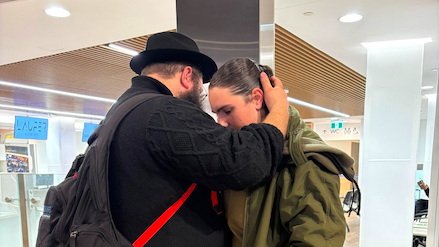
Earlier this morning, I was walking to the bus stop with my daughter. I was wearing my usual black and white, what I sometimes think of as my standard-issue Chabad uniform. She was in her full IDF uniform, including her army skirt.
I couldn't help chuckling at the picture we must have made, particularly as we hugged goodbye at the bus stop.
A passing stranger might have seen a Charedi man embracing an Israeli soldier and wondered what to make of us. With military service and the place of Charedim in Israeli society so much a part of the national conversation, perhaps our clothing would have suggested a mild contradiction.
To us, it was an ordinary morning. A father and daughter walking together, heading where we needed to go. We didn't need to reconcile anything for each other. We already knew who we were to one another.
This has stayed with me because I've spent a lot of time lately wondering where I belong.
We moved to Israel only a few months ago, and I've discovered that identities don't always travel as smoothly as people do. The words may be the same, while the expectations attached to them can change considerably.
Take Chabad. In so many ways, it is immediately familiar.
But Chabad in Israel also occupies a different place in the broader Jewish landscape. Its relationships with other communities are different. The way people understand a shliach, and what shlichus looks like in daily life, can be different. I'm still learning the social map, sometimes discovering that a label I thought I understood means something else to the person using it.
For years, being a shliach was central to my life. It shaped my work, my friendships, my schedule, and much of my understanding of what I was supposed to contribute to the world. On a progressive American college campus, I often found myself meeting people who had never spoken seriously with a Chabad rabbi, or sometimes with any visibly religious Jew. We had to get past the first impression before we could get anywhere interesting.
I loved that part of the work.
For the first time in a long while, I no longer have a campus that defines the boundaries of my shlichus. There is something disorienting about that, and something exciting too. I find myself wondering which parts of that calling belong to a particular assignment and which parts travel with me, right down to this bus.
Actually, I think I loved it even more than I realized.
Because I genuinely enjoy crossing borders.
I like finding myself in a room where I am an unexpected presence. I like hearing the assumptions people make about my life, and the moment when those assumptions give way to an actual conversation. I enjoy being challenged by someone whose experiences are completely different from mine. And I like going into those encounters looking exactly as I do.
I have no interest in disguising my identity to make other people more comfortable. I'm proud to be a Chabad Chassid. It shapes the decisions I make every day. There are real boundaries in my life, and I value them.
Yet those commitments have also carried me into an extraordinary range of encounters. Some were comfortable. A few were awkward. Some forced me to rethink assumptions I didn't even know I held. I've rarely regretted stepping into the room.
Perhaps that is why I've never been especially interested in fitting neatly into a box. I want to belong, and I do belong. I also want the freedom to be curious beyond the places where belonging comes easily.
Of course, there's a complication here. I may resist being categorized by other people, but I do exactly the same thing to them.
Consider this bus. I know that the women behind me are wearing hijabs. That tells me something about how they present themselves in public, and perhaps something about their religious commitments. It tells me almost nothing about their families, their hopes, their politics, or what kind of morning they've had. I don't even know where they're going!
As for the three Israelis across the aisle, I've heard a few sentences about Charedim. I could build an entire story in my head about what they think of people like me. It would be a story composed mostly of guesses.
And if I resent being reduced to my clothing, what right do I have to reduce them to a headscarf or a passing remark?
I wish I could say I always remember this. I don't.
Election season makes the temptation even stronger. Political life asks us to choose between parties and competing visions of the country. The questions at stake are serious: security, military service, religion and state, and the responsibilities we owe one another. People disagree because the answers matter, often deeply.
But a ballot cannot contain everything about the person casting it. Neither can a uniform, a neighborhood, or the kind of school someone attended. Even within communities that appear fairly uniform from the outside, there is an enormous range of convictions, experiences, and private questions.
I suspect part of my discomfort is that I know how easily other people's expectations can become our own. Once the world decides what sort of person you are, it can be tempting to behave that way. A community offers belonging, but it also has assumptions about how its members should think, whom they should know, and where they should feel at home.
Which expectations do I embrace? Which deserve a second look? And how do I remain faithful to the people and commitments I love while continuing to discover new parts of myself?
I don't have a settled answer. Moving to Israel has given me the opportunity to ask these questions again, without the familiar role that answered so many of them for me before.
What I do know is that I want to keep crossing borders. Sometimes that will mean a serious conversation with someone who sees the world differently. Sometimes it will mean walking into an unfamiliar community and listening. And sometimes, wonderfully, it will mean nothing more ambitious than sharing a table, a laugh, or a good cup of coffee.
Back to my daughter and me walking down the street this morning. We weren't trying to make a statement. We were simply together, carrying our different responsibilities and recognizably part of the same family. Anyone watching might have seen the uniforms first. That would have been understandable. They just wouldn't have seen the whole picture.
My stop is coming up. I'll get off the bus and make my way to the coffee shop (and publish this piece). I have no idea who I'll meet there or whether I'll speak to anyone at all. Perhaps I'll simply sit down and write some more.
Either way, I'm not planning on changing my clothes.
I'd rather see where I can go wearing them.